
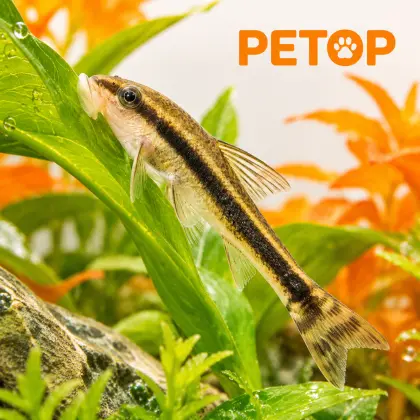
Otocinclus
A tiny schooling algae-eating catfish for planted tanks.
Behavior traits
Scores from 1 to 5 reflect breed averages; every animal has its own personality.
Otocinclus is a genus of freshwater ray-finned fish belonging to the family Loricariidae, the suckermouth armoured catfishes, and the subfamily Hypoptopomatinae, the cascudinhos. The catfishes in this genus are found in South America. These catfishes are commonly known as "dwarf suckers" or "otos". This genus, like other loricariids, is characterized by rows of armour plating covering the body, as well as the underslung suckermouth. They are generally small in size; O. tapirape is the smallest of the species (2.4 cm), while O. flexilis is the biggest (5.5 cm). These species have adaptations that allow them to breathe air. A duct forms at the junction between the esophagus and the stomach and expands into an enlarged, ring-like diverticulum, characteristic of this genus, which allows air-breathing. Otocinclus are popular aquarium fish, and they are often purchased as algae eaters. It is difficult to breed them in captivity, and mostly wild caught Otocinclus are available to hobbyists. This genus is widely distributed east of the Andes of South America, throughout the lowlands from northern Venezuela to northern Argentina, but are generally absent from the Amazon and the Orinoco lowlands.
General care guide: Fish & aquatics
Cycle first
Run your tank for 3–4 weeks before adding fish so beneficial bacteria can convert ammonia. Test water regularly.
Essentials
Filter, heater for tropicals (24–28°C), dechlorinator and a test kit. Feed small amounts once or twice daily and change 20–25% of the water weekly. Never release fish into the wild.
Frequently asked questions
How long does a Otocinclus live?
A Otocinclus typically lives about 3-5 years, and good nutrition and regular checkups can extend that.
Is a Otocinclus good for apartments?
Yes — with enough daily activity, a Otocinclus adapts well to apartment life.
Is a Otocinclus good with children?
Yes — a Otocinclus is usually gentle and patient with kids, though play should always be supervised.